


Page 26 - Koi Net - On-Line Koi Magazine - Issue 30
P. 26
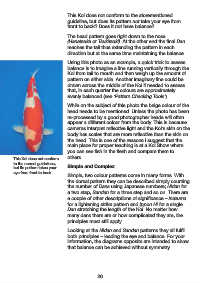
This Koi does not conform to the aforementioned
                             guideline, but does its pattern not take your eye from
                             front to back? Does it not have balance?

                             The head pattern goes right down to the nose
                             (Hanatsuke or Tsukitsuki). At the other end the final Dan
                             reaches the tail thus extending the pattern in each
                             direction but at the same time maintaining the balance.

                             Using this photo as an example, a quick trick to assess
                             balance is to imagine a line running vertically through the
                             Koi from tail to mouth and then weigh up the amount of
                             pattern on either side. Another imaginary line could be
                             drawn across the middle of the Koi if needed to assess
                             that, in each quarter the colours are approximately
                             evenly balanced (see ‘Pattern Checking Tools’).
                             While on the subject of this photo the beige colour of the
                             head needs to be mentioned. Unless the photo has been
                             re-processed by a good photographer heads will often
                             appear a different colour from the body. This is because
                             cameras interpret reflective light and the Koi’s skin on the
                             body has scales that are more reflective than the skin on
                             the head. This is one of the reasons I suggest that the
                             main place for proper teaching is at a Koi Show where                               Moving on to the next group – the more complex
                             you can see fish in the flesh and compare them to                                   patterns – 3 colours or more. Probably the most
                             others.                                                                             common of these are the Sanshokus (literal translation
       This Koi does not conform                                                                                 = three colours); the Taisho Sanshoku or Sanke and the
       to the normal guidelines,
       but its pattern takes your   Simple and Complex                                                           Showa Sanshoku or Showa. Although not gifted with
       eye from front to back.                                                                                   the suffix Sanshoku the Beni Kumonryu is another
                             Simple, two colour patterns come in many forms. With                                example of a complex 3 colour pattern. Those colours
                             the dorsal pattern they can be described simply counting                            being red (Beni), black (Sumi) and white (Shiro). All
                             the number of Dans using Japanese numbers; Nidan for                                three of these Koi are a meld of characteristics
                             a two step, Sandan for a three step and so on. There are                            belonging to two separate varieties.
                             a couple of other descriptions of significance – Inazuma
                             for a lightening strike pattern and Ippon Hi for a single                           The Sanke has a combination of two dorsal patterns.
                             Dan stretching the length of the Koi. No matter how                                 Those of the Kohaku and the Bekko on a white ground.
                             many dans there are or how complicated they are, the
                                                                                                                 The Showa a combination of the Kohaku dorsal pattern
                             principles must still apply.
                                                                                                                 with the wrapping pattern of an Utsuri. (Technically
                             Looking at the Nidan and Sandan patterns they all fulfil                            the Showa is a black skinned Koi, but in terms of
                             both principles – leading the eye and balance. For your                             appreciation we discuss the black as if it were a colour.)
                             information, the diagrams opposite are intended to show
                                                                                                                 The Beni Kumonryu a combination of the linear
                             that balance can be achieved without symmetry.
                                                                                                                 Kumonryu pattern and that of the dorsal Kohaku pattern.
                                                                                              Beni Kumonryu      Each of the above have a Metallic, Doitsu and Tancho
                                                                                                                 variant. The Tancho variant has only a single Beni Dan

                                          26                                                                                  27

