


Page 25 - Koi Net - On-Line Koi Magazine - Issue 30
P. 25
Both of these principles are true whether it is a Koi with                          Starting Points – Left to Right
                             a simple pattern (one colour) or a more complex pattern
                             with two or more colours.

                             Having established that, let us consider the pattern
                             types. I’m told that there are four, but one of them (the
                             solid) doesn’t fit into my definition above. Nevertheless,
                             I will include in the diagram below so that you can
                             decide for yourself.


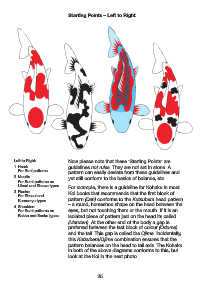
                                                                                           Left to Right:        Now please note that these ‘Starting Points’ are
                                                                                           1. Head:              guidelines not rules. They are not set in stone. A
                                                                                             For Beni patterns.
                                                                                                                 pattern can easily deviate from these guidelines and
                                                                                           2. Mouth:             yet still conform to the basics of balance, etc.
                                                                                             For Sumi patterns on
                                                                                             Utsuri and Showa types.  For example, there is a guideline for Kohaku in most
                                                                                           3. Flanks:            Koi books that recommends that the first block of
                                                                                             For Shusui and
                                                                                            Kumonryu types.      pattern (Dan) conforms to the Kutsubera head pattern
       Left to Right:        Let us look at the three on the right.                                              – a round, horseshoe shape on the head between the
       Solid (no pattern),                                                                 4. Shoulder:
       Dorsal type,          The Kohaku has a dorsal type pattern that conforms              For Sumi patterns on   eyes, but not touching them or the mouth. If it is an
       Wrapped type and      to the principles. It takes your eye from front to back         Bekko and Sanke types.  isolated piece of pattern just on the head its called
       Linear type.                                                                                              (Maruten). At the other end of the body a gap is
                             and it has balance, as does the Showa. On the
                                                                                                                 preferred between the last block of colour (Odome)
                             Kumonryu we have to take into account the specific
                                                                                                                 and the tail. This gap is called the Ojime. Incidentally,
                             guidelines for the variety – a linear Sumi pattern on
                                                                                                                 this Kutsubera/Ojime combination ensures that the
                             the flanks and a bald head.
                                                                                                                 pattern balances on the head to tail axis. The Kohaku
                             This brings me on to another pattern element to                                     in both of the above diagrams conforms to this, but
                             consider – its starting or key point.                                               look at the Koi in the next photo.


                                          24                                                                                  25

