


Page 55 - Koi Net - On-Line Koi Magazine - Issue 30
P. 55
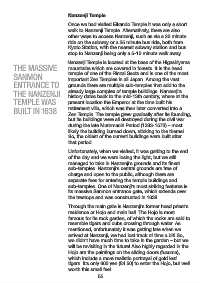
Right:                                                                                                    Nanzenji Temple
       One of Nanzenji’s striking
       features is its massive                                                                                   Once we had visited Eikando Temple it was only a short
       Sanmon entrance gate.                                                                                     walk to Nanzenji Temple. Alternatively, there are also
                                                                                                                 other ways to access Nanzenji, such as via a 20 minute
                                                                                                                 ride on the subway or a 35 minute bus ride, both from
                                                                                                                 Kyoto Station, with the nearest subway station and bus
                                                                                                                 stop to Nanzenji being only a 5-10 minute walk away.

                                                                                                                 Nanzenji Temple is located at the base of the Higashiyama
                                                                                           THE MASSIVE           mountains which are covered in forests. It is the head
                                                                                           SANMON                temple of one of the Rinzai Sects and is one of the most
                                                                                                                 important Zen Temples in all Japan. Among the vast
                                                                                           ENTRANCE TO           grounds there are multiple sub-temples that add to the
       Below:                                                                                                    already large complex of temple buildings. Nanzenji’s
       Nanzenji Temple is the                                                              THE NANZENJI
       head temple of one of the                                                                                 history dates back to the mid-13th century, where at the
       Rinzai Sects and is one of                                                          TEMPLE WAS            present location the Emperor at the time built his
       the most important Zen                                                                                    retirement villa, which was then later converted into a
       Temples in all Japan.                                                               BUILT IN 1638
                                                                                                                 Zen Temple. The temple grew gradually after its founding,
                                                                                                                 but its buildings were all destroyed during the civil war
                                                                                                                 during the late Muromachi Period (1333-1573) – most
                                                                                                                 likely the building burned down, sticking to the theme!
                                                                                                                 So, the oldest of the current buildings were built after
                                                                                                                 that period.
                                                                                                                 Unfortunately, when we visited, it was getting to the end
                                                                                                                 of the day and we were losing the light, but we still
                                                                                                                 managed to take in Nanzenji’s grounds and its finest
                                                                                                                 sub-temples. Nanzenji’s central grounds are free of
                                                                                                                 charge and open to the public, although there are
                                                                                                                 separate fees for entering the temple buildings and
                                                                                                                 sub-temples. One of Nanzenji’s most striking features is
                                                                                                                 its massive Sanmon entrance gate, which extends over
                                                                                                                 the treetops and was constructed in 1638.

                                                                                                                 Through the main gate is Nanzenji’s former head priest’s
                                                                                                                 residence or Hojo and main hall. The Hojo is most
                                                                                                                 famous for its rock garden, of which the rocks are said to
                                                                                                                 resemble tigers and cubs crossing through water. As
                                                                                                                 mentioned, unfortunately it was getting late when we
                                                                                                                 arrived at Nanzenji, we had lost track of time a bit! So,
                                                                                                                 we didn’t have much time to take in the garden – but we
                                                                                                                 will be revisiting in the future! Also highly regarded in the
                                                                                                                 Hojo are the paintings on the sliding doors (fusuma),
                                                                                                                 which include a more realistic portrayal of gold leaf
                                                                                                                 tigers. It’s only 600 yen (£4.50) to enter the Hojo, but well
                                                                                                                 worth this small fee!
                                          54                                                                                  55

