


Page 35 - Koi Net - On-Line Koi Magazine - Issue 30
P. 35
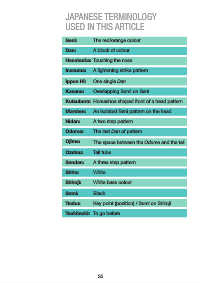
My tool for assessing balance is known as ‘halving and                             JAPANESE TERMINOLOGY
                             quartering’. If a pattern is properly balanced you should
                             see evenly distributed elements of pattern in each                                 USED IN THIS ARTICLE
                             quarter by drawing imaginary lines through the Koi.
                             I’d like to stress here that these are my methods that I                           Beni:       The red/orange colour
                             have acquired from the teachings of many people.
                             There are others.                                                                  Dan:        A block of colour

                                                                                                                Hanatsuke: Touching the nose
                                                                                                                Inazuma:    A lightening strike pattern

                                                                                                                Ippon Hi:   One single Dan

                                                                                                                Kasane:     Overlapping Sumi on Beni
                                                                                                                Kutsubera:  Horseshoe shaped front of a head pattern

                                                                                                                Maruten:    An isolated Beni pattern on the head

                                                                                                                Nidan:      A two step pattern
                                                                                                                Odome:      The last Dan of pattern

                                                                                                                Ojime:      The space between the Odome and the tail

                                                                                                                Ozutsu:     Tail tube
                                                                                                                Sandan:     A three step pattern

                             Show Classes                                                                       Shiro:      White

                             The majority of the Show Classes deployed at Koi                                   Shiroji:    White base colour
                             Shows are based on patterns to allow for judges to
                             assess like with like. For example:                                                Sumi:       Black

                             Kohaku, Bekko, Utsurimono, Asagi/Shusui concentrate                                Tsubo:      Key point (position) / Sumi on Shiroji
                             on simple patterns. Sanke and Showa on the complex
                             patterns. Hikari-Muji and Mujimono on the so-called                                Tsukitsuki: To go before
                             solid patterns, i.e. single coloured Koi.

                             The other classes focus on other attributes. For example:
                             Kinginrin (Metallic Scales), Tancho (Head Patterns),
                             Koromo (Robing).
                             Hikari-Moyo and Hikari-Utsuri focus on Metallic skins
                             (white for Moyo and black for Utsuri).
                             Leaving Kawarimono to cater for all that is left.
                                          33                                                                                  35

